Illustration of rows of solar panels over barren land with toxic waste barrels and dead fish in a polluted stream, captioned fightgranbysolarfarm.com

665 acres. An out-of-state hedge fund.
Our water. Our town.

A New York hedge fund wants to cover 665 acres of Granby and East Granby with an industrial solar power plant, over the Salmon Brook watershed and on land soaked in decades of nursery chemicals.

We are not against solar energy. We are against putting a 100-megawatt industrial power plant in the wrong place, with the profits leaving town and the risks left behind.

πŸ“ Status, June 2026: DESRI has not yet filed its petition with the Connecticut Siting Council. That is exactly why now is the time to organize.  Watch the CSC docket β†’

Want to fight this? Start here.

Pick one thing to do today

You do not need to be a lawyer, an engineer, or an activist. The most powerful thing two neighbors can do is create a paper trail. Choose a starting point.

1

Tell your town officials

Ask the Granby and East Granby Boards of Selectmen to formally oppose the project, as North Stonington's board did. A town that fights as a party carries the most weight.

Get the contacts
2

Download a letter

We wrote ready-to-send letters and comment templates. Open one in Word, add your name and address, print, and mail. Fifteen minutes, real impact.

Get the templates
3

Spread the word

Share this site with three neighbors. The Siting Council counts voices on the record. The more residents who show up, the harder this is to approve on a close vote.

Copy the link

The Project

What is actually being proposed

Broadleaf Solar is a 100-megawatt utility-scale photovoltaic plant planned for the former Monrovia Nursery land at 35 Floydville Road and 90 Salmon Brook Street, spanning two towns. Because it falls under the Connecticut Siting Council, it can bypass local zoning, planning, and wetlands review entirely.

100 MW
Industrial-scale power plant
665
Acres cleared and graded
(322 Granby / 343 East Granby)
2 to 4
Permanent local jobs
$0
Reduction to your electric bill

βš–οΈ Why your town board can't stop it alone: Connecticut routes large energy projects to the state Siting Council, which can override Granby's local zoning, planning & zoning, and inland wetlands commissions. The fight is not at Town Hall, it is at the Siting Council, and the public has a real, legal role there. See how the process works β†’

Follow the money

Who is behind this

This is not a local solar co-op. The developer is the renewable-energy arm of one of the largest hedge funds in the world.

The Developer

DESRI, D.E. Shaw Renewable Investments

The renewable arm of D.E. Shaw & Co., a New York hedge fund managing roughly $60 billion. DESRI develops, owns, and operates utility-scale solar across the country. It bought the Granby nursery land in 2021 for about $7.2 million.

The electricity, the tax credits, and the profits flow to investors. What stays in Granby is 665 acres of fenced industrial equipment and whatever is left in the soil and water.

Sources: Granby town information page; Granby Drummer coverage.
The Pattern

Built to roll through small towns

Utility-scale developers count on small towns where no one shows up to the hearings. The state process is technical, slow, and intimidating by design.

But the same process is also public and document-driven. Every question the developer must answer, every study they have not done, and every concern placed on the record becomes a vulnerability, and grounds for appeal. Towns that organize early and file real documents have stopped, shrunk, and delayed these projects.

See "Towns That Fought Back" below.

The promised benefits, checked

Jobs and taxes: the reality

The developer will talk about jobs and tax revenue. Here is what those numbers actually look like for Granby and East Granby.

Construction Jobs
200 to 300

workers for 12 to 18 months, but these are specialized solar crews brought in by the contractor, not local hires. They leave when the panels are installed.

Permanent Jobs
2 to 4

full-time technicians, plus a seasonal vegetation crew a few times a year. That is the total permanent local employment, typically filled by regional contractors.

Tax Revenue
~$600K

per year to Granby under Connecticut's uniform solar capacity tax ($10,000/MW). It is fixed, typically for 20 years, with no inflation adjustment and no reassessment.

Your Power Bill
No change

The ~160,000 MWh per year goes to the regional wholesale grid. Granby residents see no discount unless a community benefit agreement is negotiated, none has been offered.

πŸ’‘ The bottom line: Granby gets a fixed tax check and an industrial landscape. The power, the revenue, and the profits leave town. A handful of permanent jobs is the entire economic upside, weighed against the water, the soil, the views, and the character of two towns.

Toxic waste & chemicals

What this could put in our soil, air, and water

This is the heart of the case. Three documented risk areas converge on a single drinking-water watershed. None has been fully studied by the developer.

In the Ground Already

πŸ§ͺ Legacy nursery chemicals

Decades of commercial nursery operations almost certainly left pesticide and herbicide residues in the soil, arsenic, lead, DDT/DDE, chlordane and similar persistent pollutants are common on old nursery sites. DESRI's own Cornell soil study noted "limited topsoil from decades of agricultural use."

Grading and trenching 665 acres can mobilize those legacy contaminants into groundwater. No Phase II environmental assessment has been done.

We are demanding a full Phase II site assessment before any approval.
In the Panels

♾️ PFAS "forever chemicals"

Peer-reviewed research (Springer, 2026) confirms PFAS in solar-panel backsheets, and University of Michigan work documents leaching risk as panels weather, crack, and degrade over 25+ years. Across 665 acres draining to Salmon Brook, the cumulative loading is significant.

Connecticut regulates PFAS in drinking water at parts-per-trillion. This angle has never been raised at the CT Siting Council, Granby could be the first.

Source: Springer 2026; EPA PFAS roadmap; CT PFAS drinking-water standards.
In the Batteries

πŸ”₯ Battery fire & toxic smoke

Most utility-scale solar includes lithium-ion battery storage. Thermal-runaway fires are documented (Arizona's 2019 McMicken explosion hospitalized firefighters) and release hydrogen fluoride and hydrogen cyanide.

Granby is served by a volunteer fire department with no equipment or training for a lithium battery fire, and there is no evacuation plan for nearby homes. Equipping and training for a battery fire (new apparatus, Class B foam, hazmat gear, specialized recurring training) could cost the town hundreds of thousands to millions of dollars, and DESRI has made no commitment to pay for it.

Standards: NFPA 855, UL 9540A. Source: Larsson et al., Scientific Reports 2017.
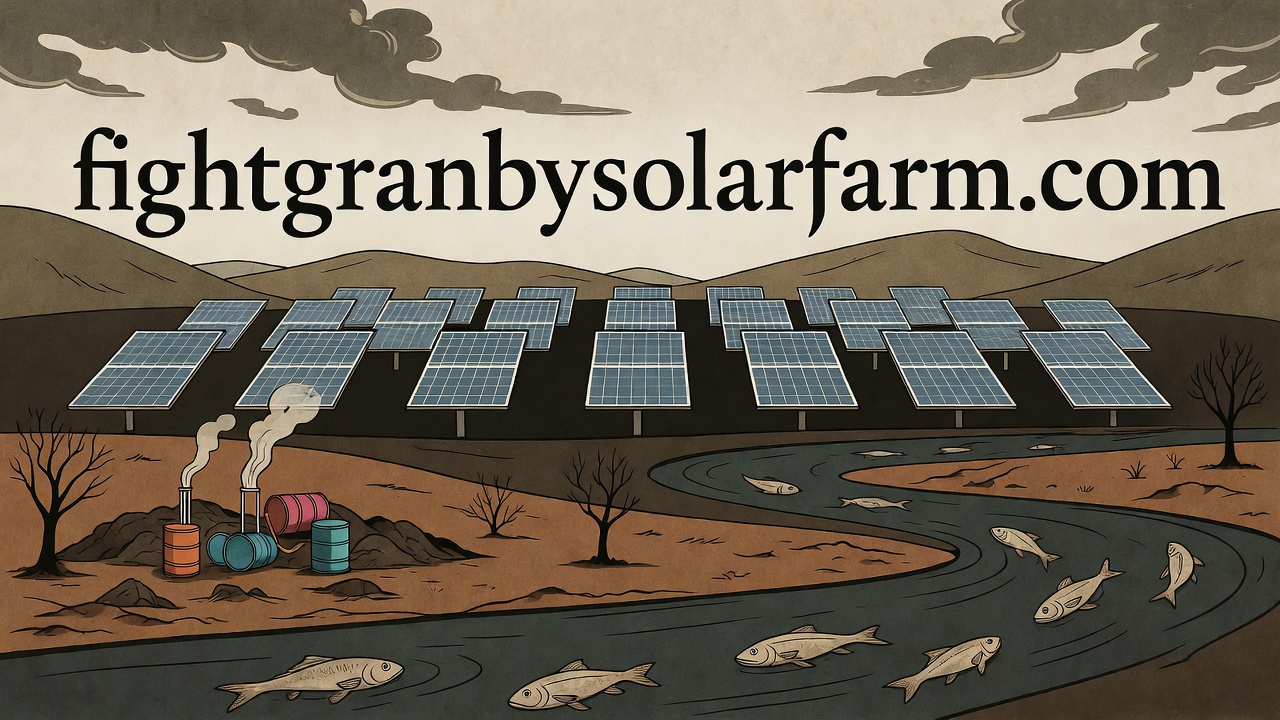
🌊 It all drains to one place: the Salmon Brook watershed, a source of drinking water for homes on private wells. The developer even plans to drill horizontally under Salmon Brook. Soil disturbance, panel runoff, and battery risk all converge on the same water that families drink. And it is home to protected wildlife →

The wildlife at stake

665 acres of habitat, cleared and fenced

This open former-farmland, its forest edges, wetlands, and the Salmon Brook corridor are exactly the habitat that protected Connecticut species depend on. No species survey of this parcel has been made public, which is the point: the developer should have to prove what lives here before bulldozing it.

Federally Endangered

πŸ¦‡ Northern long-eared bat

Listed as federally endangered. It roosts under tree bark and forages along forest edges and over water, the wooded margins and Salmon Brook running through this very site.

CT Endangered / Threatened

🐦 Grassland birds

The bobolink (Special Concern), eastern meadowlark (Threatened), and grasshopper sparrow (Endangered) nest on the ground in open fields. Hundreds of acres of open former-nursery land is prime, and increasingly rare, nesting habitat.

CT Special Concern

🐒 Wood turtle

A Species of Greatest Conservation Need tied to clean streams and their floodplains. The Salmon Brook corridor is classic wood-turtle habitat, and stream and sediment disturbance hits it directly.

CT Special Concern

🐒 Eastern box turtle

Needs exactly this field-plus-woodland-edge mosaic. Slow moving and long lived, it is extremely vulnerable to land clearing, grading, and the construction traffic this project brings.

CT Endangered

πŸ¦‡ Tricolored bat

One of Connecticut's most endangered mammals after white-nose syndrome collapsed its numbers (also proposed for federal listing). With so few left, every remaining patch of foraging habitat matters.

Vernal pools

🐸 Pool-breeding amphibians

Vernal pools across 665 acres are breeding grounds for salamanders, including the state-protected Jefferson salamander, which need large undisturbed forest buffers that grading would destroy.

πŸ”¬ The ask: demand that the Council require an independent endangered-species review (CT DEEP Natural Diversity Data Base) and full wetland delineation before any vote. In the Candlewood Mountain case, DEEP putting "materially adverse effect" on the record is what gave residents their strongest legal footing.

Cutting through the pitch

What they say vs. what's true

Expect a polished "good neighbor" presentation. Here is how the most common claims hold up.

They say

"It's clean, green energy for Connecticut."

The reality

The power feeds the regional wholesale market. It does not lower a single Granby electric bill, and "green" does not mean placing an industrial plant over a drinking-water watershed on chemically loaded land.

They say

"It brings jobs to the community."

The reality

Construction crews are specialized and imported. Permanent local employment is 2 to 4 technicians. That is the entire ongoing job impact.

They say

"The town gets valuable tax revenue."

The reality

A fixed ~$600K/year with no inflation adjustment, typically locked for 20 years, against permanent loss of 665 acres and risk to property values for every neighbor.

They say

"It's safe and fully studied."

The reality

No Phase II soil assessment, no public PFAS analysis, no wetland delineation released, and no fire plan for our volunteer department. "Safe" is an assertion, not yet a demonstrated fact on the record.

They say

"This is already a done deal."

The reality

As of June 2026 no petition has even been filed. Connecticut towns have denied, shrunk, and delayed these projects. The record is made of documents, and that is a battlefield two determined neighbors can fight on.

It has been done before

Towns that fought back, and won concessions

Across the country, 459 communities in 44 states have adopted serious restrictions on large renewable-energy siting (Columbia University, 2025), a 16% jump in a single year. These are the cases closest to ours.

Connecticut, PROJECT DENIED

North Stonington

The town hired an independent environmental engineer, documented vernal pools and wetlands, raised archaeological concerns, and asked the Siting Council to scale the project down. The result: a 3 to 3 tie, which denied the petition. This is the best Connecticut precedent and a direct model for Granby.

Connecticut, SCALED DOWN

Candlewood Mountain, New Milford

A volunteer group, "Rescue Candlewood Mountain," organized opposition and appealed the approval to Superior Court, arguing the developer failed to address vernal pools and rare species. The pressure forced the project to be significantly scaled back.

Connecticut, TOWN OPPOSED

Manchester

The town formally opposed at the Siting Council using technical evidence that the stormwater plan would worsen existing groundwater problems, and residents documented real flooding on their own properties. Stormwater was the wedge.

New York, DELAYED FOR YEARS

Copake (Sensible Solar)

Facing a state siting body that overrode local zoning, exactly Granby's situation, residents passed a local solar law protecting prime farmland, joined a multi-town lawsuit, and tied the project up for years. Their playbook directly informs ours.

πŸͺ§ The lesson: none of these towns out-spent the developer. They out-documented them, independent studies, wetland evidence, stormwater data, and relentless participation in the record. That is a fight neighbors can win.

We support solar, just not here

A better use for this land

Opposing this project is not opposing clean energy. There are uses for 665 acres of open Granby land that keep its rural character, create real local jobs, and can pay the town as well as a fixed solar tax check, without the chemicals, the fire risk, or the industrial fences.

Option 1

🌾 Preserve it as farmland

Connecticut's Farmland Preservation Program buys the development rights so the land stays open and farmed, permanently. The pitch is simple: instead of industrial solar or sprawl, protect this as farmland forever.

Option 2

🚜 A working farm or agritourism

Pick-your-own, an equestrian center, a cidery, a farm-to-table or events venue. Models like Chamard Vineyards show how open land can generate local jobs, local spending, and higher surrounding property values.

Option 3

β˜€οΈ A little, local solar

If solar belongs here at all, it is 20 to 30 acres of community solar that actually discounts Granby and East Granby residents' bills, with the other 600+ acres preserved. Green-energy benefit, no industrial eyesore.

The playbook

How the fight actually works

The Connecticut Siting Council process is public and built around documents. Here is the path, and where ordinary residents have real power.

Now, before they file

Organize & prepare

File public-records (FOIA) requests, ask the town boards to oppose, build a citizens' group, and get ready to act the day a petition appears. Everything done now makes the later fight stronger.

Days 1 to 30 after filing

File to intervene

Any affected resident can apply for intervenor status under CGS §16-50n, free, and it gives you legal standing to submit evidence, question the developer, and appeal. The window is ~30 days. Do not wait. Download the ready intervenor letter →

Discovery

Ask the hard questions

Intervenors submit written interrogatories the developer must answer under oath, on PFAS, soil testing, stormwater, fire plans, real job numbers, and decommissioning. We have 77 questions drafted and ready. Download all 77 questions →

Hearings & comment

Pack the record

Submit written comments, give statements, and fill the room at the public hearing. The more documented, specific concerns on the record, the harder it is to approve on a close vote.

Decision & appeal

Hold the line

A tie vote denies the petition (as in North Stonington). If approved, intervenors can appeal to Superior Court, and the record we built is what makes an appeal possible.

What two people can do for $0

File as an intervenor β€’ submit interrogatories β€’ file FOIA requests β€’ write a technical brief from published science β€’ submit public comments β€’ draft a petition for conditions. The CSC process does not care about the size of your bank account, it cares about the record.

Where money helps (later)

An independent environmental engineer ($10 to 25K, what North Stonington did) is the highest-value spend, fundable by the community. Save attorney money for a possible Superior Court appeal.

In the Candlewood Mountain fight, residents organized as a group, partnered with their town, and were represented by Cramer & Anderson (attorney Daniel Casagrande). Connecticut also has environmental-law help worth a call: Save the Sound and the UConn and Yale environmental clinics, which take organized community groups as clients.

Our strongest angles

PFAS in the watershed (never raised at the CSC before) β€’ legacy nursery contamination with no Phase II β€’ stormwater across 665 acres β€’ battery fire risk for a volunteer department β€’ a farmland-preservation alternative.

The monkey wrench

Fastest ways to slow this down

You do not have to defeat the whole project to stop it. You force the gaps onto the record. Each item below is a real hole in the developer's case and a legitimate reason the Council should pause, condition, or deny. Pick one and make them answer for it.

Roadblock 1

πŸ§ͺ Demand the Phase II soil test

They have not done one, on land that was a commercial nursery for decades. Insist the Council require a full Phase II environmental site assessment before any vote. It is slow, expensive, and may surface contamination that sinks the project.

Roadblock 2

♾️ Raise PFAS, a first in CT

PFAS from panel backsheets has never been argued at the CT Siting Council. Putting peer-reviewed PFAS science on the record forces them to address forever chemicals in our drinking-water watershed, an issue they have no prepared answer for.

Roadblock 3

πŸ”₯ Make them fund the fire plan

Our volunteer department cannot fight a lithium battery fire. Upgrading capability runs into the hundreds of thousands to millions, unfunded by DESRI. Demand a funded fire-safety plan and evacuation plan as a condition, or denial.

Roadblock 4

🐸 Wetlands & vernal pools

Demand an independent wetland delineation of all 665 acres. Documented vernal pools and protected habitat are exactly what helped deny the North Stonington project.

Roadblock 5

🌊 Stormwater across 665 acres

Clearing and grading a huge slice of the Salmon Brook subwatershed is genuinely complex. Stormwater evidence was the wedge that drove Manchester's opposition. Demand full modeling for every design storm.

Roadblock 6

❓ File the 77 questions

Every interrogatory they dodge becomes a gap in their petition and a ground for appeal. The full set is written and ready.

⏳ Why this works: the Siting Council runs on a record and a clock. Each unanswered question, missing study, and documented risk forces more review, more cost, and a weaker petition. You are not asking them to lose, you are making it expensive and slow to win.

Ready-to-send

Download a letter and send it

Open any of these in Microsoft Word or Google Docs, fill in the highlighted blanks with your name and address, then print and mail or email. Every one is written, sourced, and ready, all you add is your voice.

Take action

Who to call and email

These are the people who decide, represent, or answer for this project. Be brief, be specific, and be polite, name the Broadleaf Solar project, say you live in Granby or East Granby, and say what you want. A short, courteous, specific message is the most effective.

⭐ The decision-maker: Connecticut Siting Council

Connecticut Siting Council

The state body that will rule on this project
Mail Ten Franklin Square, New Britain, CT 06051
Address to Melanie Bachman, Executive Director

Written comments can be mailed or emailed any time while a petition is pending. Reference the Broadleaf Solar petition number once it is assigned.

The developer: DESRI / Broadleaf Solar

Tell them directly what the community thinks
Contact Aaron Svedlow, project representative (DESRI)

Public, on-the-record opposition to the developer signals organized resistance early, before they have spent on a full petition.

πŸ›οΈ Your town leaders, ask them to oppose it formally

Town of Granby

First Selectman Mark Fiorentino & Board of Selectmen
Mail 15 North Granby Road, Granby, CT 06035
Town Manager Michael Walsh (mwalsh@granby-ct.gov)

Town of East Granby

First Selectman Jason Hayes & Board of Selectmen
Mail 9 Center Street, East Granby, CT 06026

πŸ“¨ Your state legislators, they can push Siting Council reform

State Senator Paul Honig

Connecticut Senate, 8th District (includes Granby)
Mail Legislative Office Building, Hartford, CT 06106

State Rep. Mark Anderson

Connecticut House, 62nd District (lives in Granby)
Mail LOB Room 4200, 300 Capitol Ave, Hartford, CT 06106

πŸ‡ΊπŸ‡Έ Your federal delegation

U.S. Rep. Jahana Hayes

Connecticut's 5th Congressional District
Phone (860) 223-8412 (Waterbury)

U.S. Senators

Richard Blumenthal & Chris Murphy
Blumenthal (860) 258-6940 (Hartford)
Murphy (860) 549-8463 (Hartford)
✍️ Not sure what to say? Use one of our downloadable letters, they are already written for each of these recipients. Add your name, address, and one sentence about why this matters to you.